
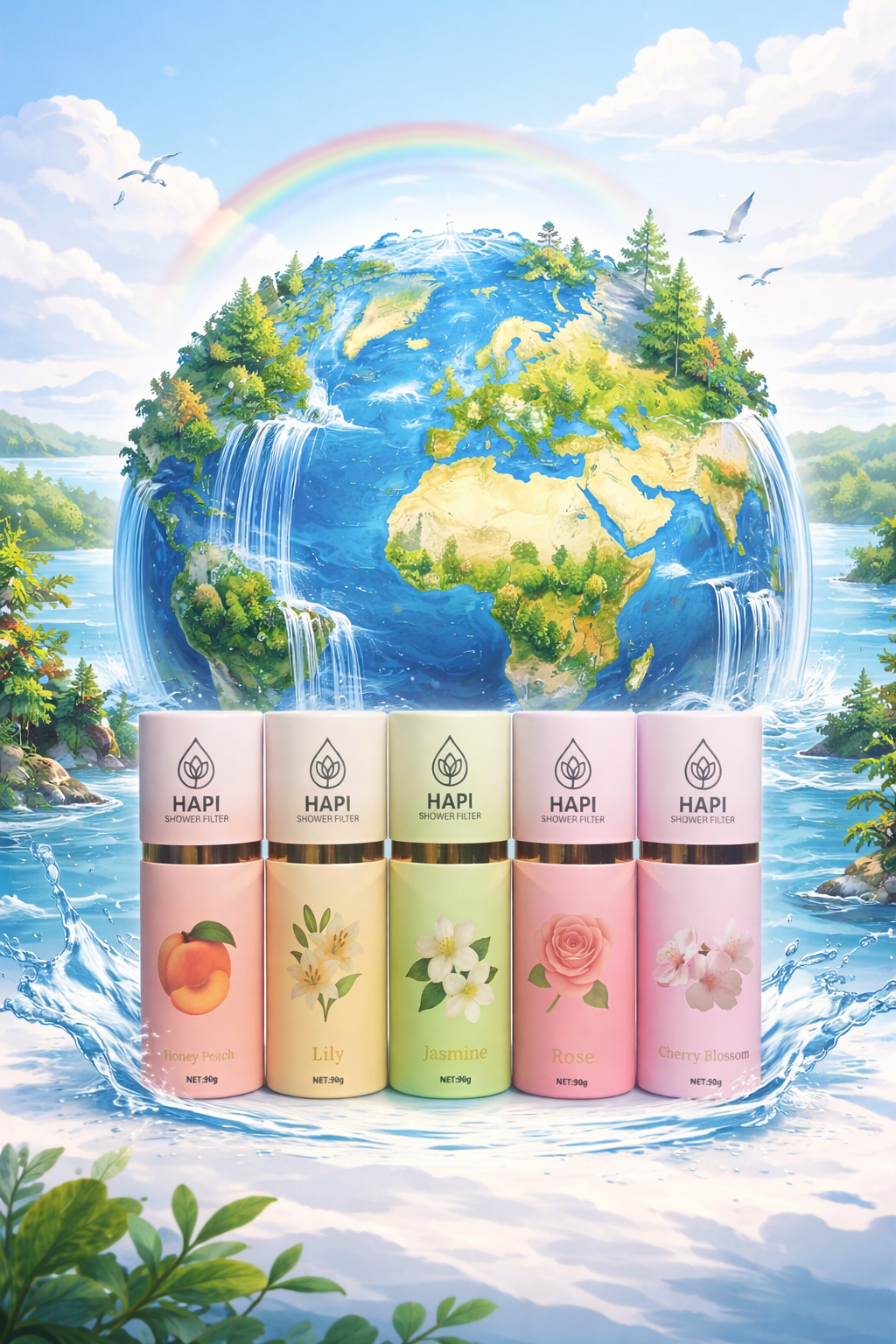
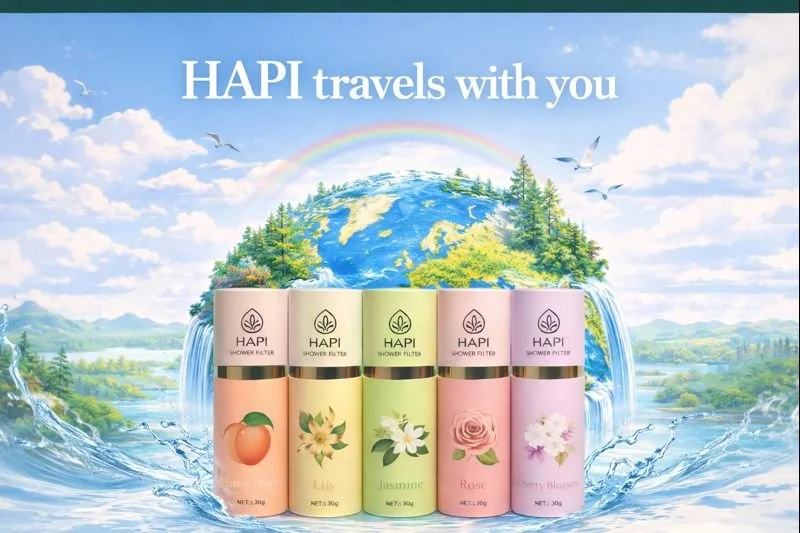
HAPI • Travel Anywhere
Why Shower Water Quality Matters Everywhere You Go
Water quality isn’t just about drinking water — the water you bathe in, steam from, and absorb through your skin also affects comfort, hair, and skin feel. Even where drinking water is treated, disinfectant residuals, hard water minerals, and pipe-borne sediment can still be present in shower water.
What shower water can do (and why you notice it while travelling)
Depending on infrastructure, treatment processes, and natural mineral content, shower water can vary widely from city to city and country to country. That’s exactly why a portable shower filter like HAPI makes sense no matter where life takes you.
Common impacts people feel
- Disinfectant residuals can create a stronger “chemical” smell in hot showers, and some sensitive people report irritation
- Hard water minerals can make hair feel brittle, frizzy, or lifeless
- Hot showers can increase exposure to some volatile disinfection by-products via inhalation and skin contact
Global overview sources: WHO (Drinking-water fact sheet) • WHO (Desalination & safe drinking-water guidance) • Exposure routes incl. showering (peer-reviewed overview)
Middle East: what travellers often notice (general overview)
Across much of the Middle East, water supply is shaped by arid climate, high demand, and limited renewable freshwater. Many cities rely heavily on treatment, long distribution networks, and (in several Gulf countries) large-scale desalination. In water-scarce settings, household or building storage tanks can also be common — and maintenance matters for water quality.
Countries commonly included in Middle East travel itineraries
Middle East / MENA overview sources: (MENA water scarcity overview) • WHO/UNICEF (Jordan RADWQ: storage tanks & contamination risk) • GCC desalinated water & consumer perceptions (peer-reviewed)
Popular travel destinations where shower water can vary
Even outside the Middle East, travellers often notice differences from disinfectant choices, mineral hardness, and local distribution systems. Here are a few practical, reputable examples.
United States
Some systems use chloramines; official guidance notes treated water meeting standards is safe for bathing, though sensitive people may notice irritation or smell differences.
US EPA (Chloramines: safe for bathing) • Minnesota Dept of Health (chlorination & bathing/showering note)
Canada
Some disinfection by-products (e.g., THMs) can contribute to total exposure via showering/bathing; this is considered in guideline setting.
Nova Scotia Gov (THMs: showering/bathing exposure) • Manitoba Gov (THMs/HAAs: showering exposure)
United Kingdom
Hard water varies by geology — a common reason travellers notice changes in hair/skin feel (lather, “tightness,” residue).
Thailand
Travel-health guidance advises avoiding tap water; if water quality is uncertain, avoid getting tap water in your mouth when showering/bathing.
CDC Yellow Book (Thailand: tap water guidance) • CDC (Food & water precautions: shower/bath mouth exposure)
Mexico
Travel-health guidance advises tap water isn’t safe to consume; if you’re unsure about local water quality, avoid getting tap water in your mouth when showering/bathing.
CDC Yellow Book (Mexico: tap water guidance) • CDC (Food & water precautions: shower/bath mouth exposure)
Australia
Chlorine/chloramine are used for disinfection; a small number of people may experience skin irritation. Water hardness also varies by city/region, changing shower “feel.”
Australia Health (chlorine/chloramine & skin irritation) • Sydney Water (hardness reference)
New Zealand
Chlorine residual is commonly used to keep supplies safe; many areas have comparatively “soft” water, but treatment and residual chlorine can affect taste/odour and shower feel.
Taumata Arowai (chlorine levels & safety) • Watercare (Auckland water: “soft” water FAQ)
Note: Some sources focus on safety (mainly ingestion). This page also covers shower experience — how disinfectants, minerals, and local systems can change skin/hair feel when travelling.
Why HAPI is designed for every destination
Water varies around the world — not only in taste or safety, but in how it feels on your skin and hair. Even when drinking water meets standards, shower water can still contain disinfectant residuals, hard minerals, rust particles, and distribution-system effects that change your shower experience, especially when travelling.
HAPI is designed to be portable and compatible with most standard shower fittings so you can take a more elevated shower experience with you — from the Middle East to Europe, to Australia & New Zealand, to tropical Asia and beyond.
Keep your shower ritual consistent.
Hotel • Airbnb • Family visits • International travel